Lavender Butterfly Crochet Bedspread
Intermediate
For crocheters comfortable with the basics, ready to try new shaping and assembly techniques
Weekend Project
A satisfying weekend make — start Friday, finish Sunday, enjoy forever.
Handmade Gift
A beautiful keepsake — free forever. Read online or print at home.
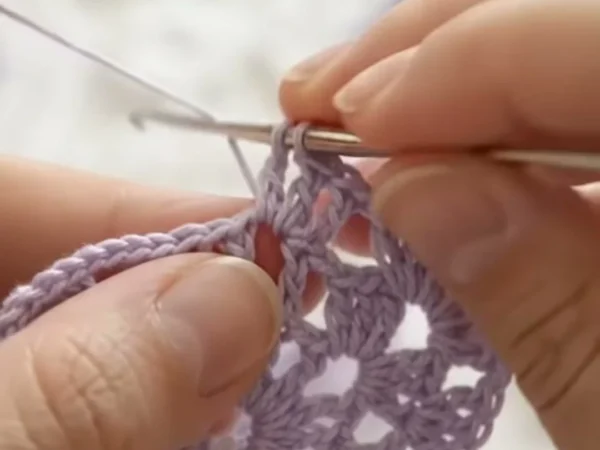 Magic ring & first rounds
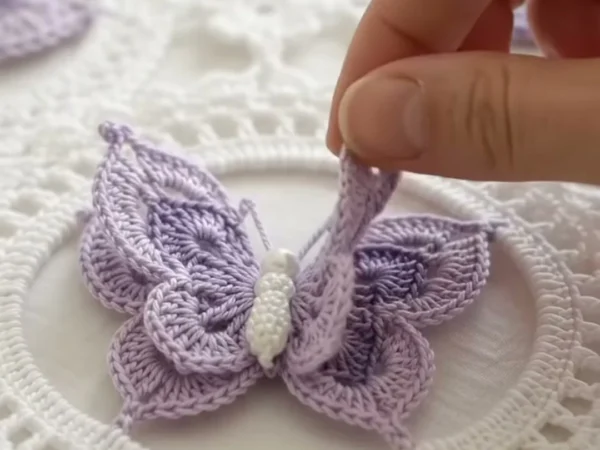 Building the shape
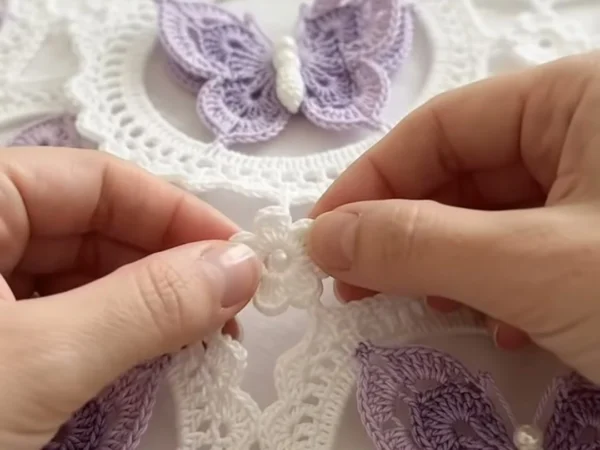 Assembly in progress
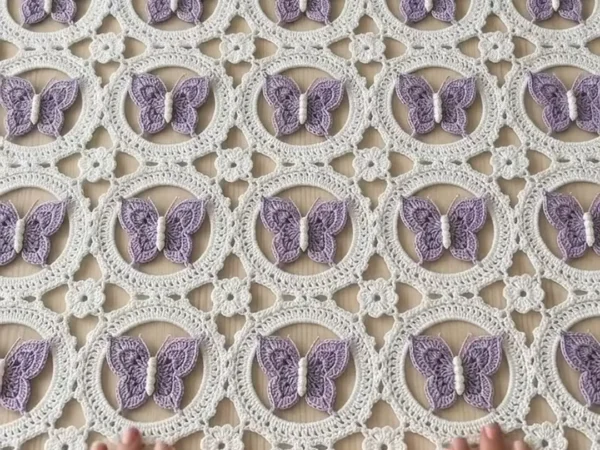 Finished & ready!
About This Lavender Butterfly Crochet Bedspread
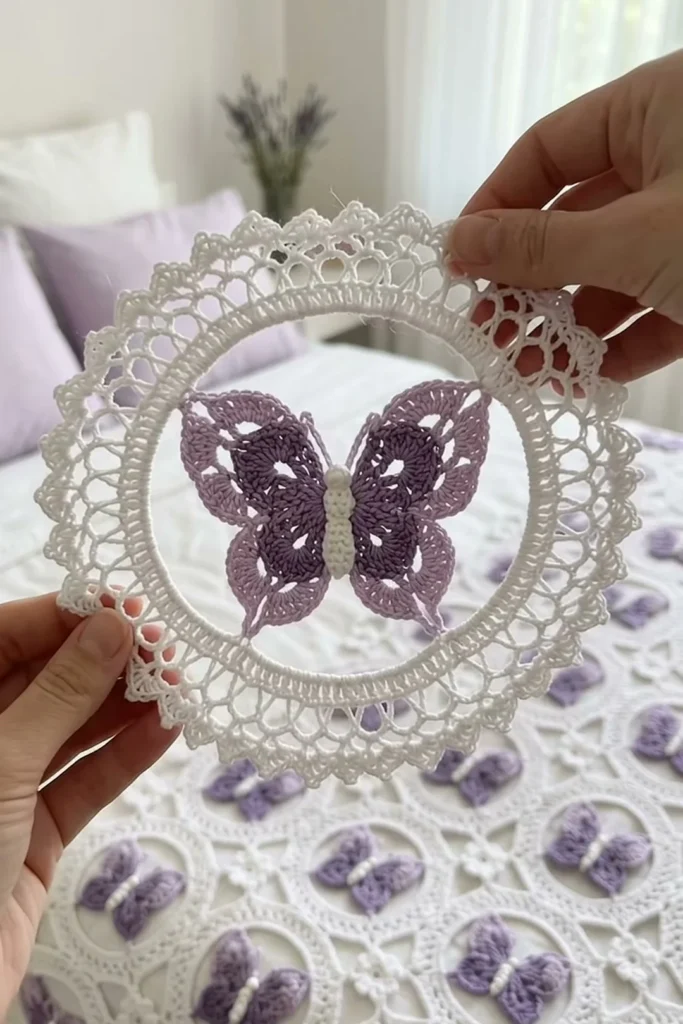
This butterfly crochet bedspread is light and airy: every motif is an open white lace ring with a lavender butterfly floating in the middle, attached only at its wing tips so the bed shows through around it. The butterflies have deep lavender centers and pale lavender lacy edges, a little white body and two curled antennae, and tiny white flowers join the rings where four of them meet.
Each motif has three parts. The ring starts from a long chain joined into a circle and grows outward in rounds of double crochet, mesh and chain loops, finishing with scallops that join to the next motif as you go. The butterfly is worked from a small center ring: four wings in the first round, a lacy outline in the second, and a picot edge in the third. The body is a tiny stuffed tube pinched into segments.
A bedspread takes about 85 to 100 hours, and a throw about 35 to 40. One ring takes about 35 minutes and one butterfly about 30. It suits a crocheter who is comfortable with double and treble crochet and likes small, detailed pieces.
Materials
- DK weight yarn, white about 3,900 m for a bedspread (16 skeins of 100 g / 250 m), or 1,650 m for a throw (7 skeins), for the rings, bodies and flowers
- DK weight yarn, pale lavender about 510 m for a bedspread (3 skeins), or 210 m for a throw (1 skein), for the wing edges
- DK weight yarn, deep lavender about 290 m for a bedspread (2 skeins), or 120 m for a throw (1 skein), for the wing centers
- 4 mm (G-6) crochet hook
- A little polyester fiberfill for the bodies
- Stitch markers to mark the wing tips and the join points
- Blocking mats and rust-proof pins
- Tapestry needle and scissors
Abbreviations
MRmagic ringchchainsl stslip stitchscsingle crochethdchalf double crochetdcdouble crochettrtreble crochetpicotch 3, sl st in the 3rd ch from the hookspspaceskskipst(s)stitch(es)rndroundreprepeatRS / WSright side / wrong sideHow the Butterfly Motif Works
The ring is built from the inside out. A long chain joined into a circle sets the size of the opening, a round of dc makes it firm, and every round after that gets airier: a mesh, then chain loops that grow from 5 to 6 chains. Longer loops on the outside give the ring the extra length it needs to stay flat without counting increases.
The butterfly starts from a ring of 8 chains. Two tall wings of treble crochet and two short wings of double crochet are worked straight into it in the first round, in deep lavender. The pale lavender outline adds fans of stitches with ch-1 holes, which makes the wings lacy, and the picot edge gives them a soft, frilly finish.
Because the butterfly is sewn to the ring only at its 4 wing tips and the top of its head, it floats in the opening and its wings lift slightly. That is what makes the bedspread look so light in the photos.
Sizes and How Many Motifs
- Each joined motif takes up about 24 x 24 cm, and the free scallops add about 2 cm on each outer edge.
- Cushion front: 4 motifs (2 x 2) and 1 flower, about 50 cm square.
- Baby blanket: 3 x 4 = 12 motifs and 6 flowers, about 75 x 100 cm.
- Throw: 5 x 6 = 30 motifs and 20 flowers, about 120 x 145 cm.
- Queen bedspread: 8 x 9 = 72 motifs and 56 flowers, about 195 x 220 cm.
- King bedspread: 10 x 9 = 90 motifs and 72 flowers, about 245 x 220 cm.
- Yarn per motif, to plan any size: about 50 m white for the ring, 2 m white for the body, 7 m pale lavender and 4 m deep lavender. Each flower uses about 3 m of white.
Open Lace Ring (make 72 for a bedspread, 30 for a throw)
- Rnd 1: with white, ch 96 and join with sl st to the first ch to form a ring, taking care not to twist the chain. (96 ch)
- Rnd 2: ch 3 (counts as dc), dc in each ch around, join with sl st to top of ch 3. (96 dc) The opening should measure about 13 cm across.
- Rnd 3: ch 5 (counts as dc and ch 2), sk next 2 sts, *dc in next st, ch 2, sk next 2 sts; rep from * 30 more times, join with sl st to 3rd ch of ch 5. (32 dc, 32 ch-2 sps)
- Rnd 4: sl st in next ch-2 sp, ch 1, sc in same sp, *ch 5, sc in next ch-2 sp; rep from * 30 more times, ch 5, join with sl st to first sc. (32 ch-5 loops)
- Rnd 5: sl st in next 3 ch, ch 1, sc in same loop, *ch 6, sc in next loop; rep from * 30 more times, ch 6, join. (32 ch-6 loops)
- Rnd 6 (first motif only): sl st in next loop, ch 1, sc in same loop, *(hdc, 7 dc, hdc) in next loop, sc in next loop; rep from * 14 more times, (hdc, 7 dc, hdc) in last loop, join. Fasten off. (16 scallops)
- Count the scallops as 4 sides of 4. The 2 middle scallops of each side join to the next motif; the 2 scallops at each corner stay free for the flowers.
Lavender Butterfly (make 1 per ring)
- Rnd 1 (wings): with deep lavender, ch 8, join with sl st to form a ring. Upper wing: ch 4 (counts as tr), 5 tr in ring, ch 4, sl st in ring. Lower wing: ch 3 (counts as dc), 4 dc in ring, ch 3, sl st in ring. Rep the upper wing and the lower wing once more. Fasten off. (2 upper wings of 6 tr, 2 lower wings of 5 dc)
- Rnd 2 (lace outline): join pale lavender in the ring at the base of an upper wing. Upper wing: work 4 dc along the side of the beginning ch 4, *ch 1, 2 dc in next tr; rep from * 4 more times, ch 1, (2 dc, ch 3, 2 dc) in the last tr for the tip, 4 dc in the ch-4 sp, sl st in ring. Lower wing: 3 dc along the side of the ch 3, *ch 1, 2 dc in next dc; rep from * 3 more times, 3 dc in the ch-3 sp, sl st in ring. Rep for the other 2 wings. (lacy fans with ch-1 holes)
- Rnd 3 (picot edge): with pale lavender, ch 1, *sc in each st and each ch-1 sp around the wing, working (sc, picot, sc) in the ch-3 tip and a picot after every 4th sc, sl st in ring between wings; rep from * for all 4 wings. Fasten off.
- Body: with white, MR, 6 sc in ring, do not join. Work 7 rnds of 6 sc in a spiral, stuffing lightly as you go. Close with a running stitch through the last rnd. Wrap the yarn tail tightly around the body at 3 evenly spaced points to make 4 round segments. (about 4 cm long)
- Antennae: with white, join at the top of the body, ch 7, sl st in 2nd ch from hook and in next 2 ch, fasten off. Rep for the second antenna. Curl them gently with your fingers.
- Sew the body down the center of the wings over the ring, covering the starting chain completely.
Setting the Butterfly in the Ring
- Lay the ring flat and place the butterfly in the opening, with the head toward one of the joining sides and the upper wings toward the top.
- With white yarn, sew the tip of each upper wing to Rnd 2 of the ring at about 10 and 2 o’clock, using 3 small stitches.
- Sew the tip of each lower wing to Rnd 2 at about 5 and 7 o’clock.
- Sew the top of the head to Rnd 2 at 12 o’clock, between the antennae. The butterfly should be held flat but not stretched.
- Set all the butterflies the same way up, so they all fly in the same direction across the bedspread.
Joining as You Go
- Layout: 8 motifs across and 9 long for a queen bedspread, or 5 across and 6 long for a throw.
- Work Rnds 1-5 of the next ring, then work Rnd 6 until you reach the first scallop that must join a finished motif.
- Joining scallop: work (hdc, 4 dc) in the loop, sl st in the 4th dc of the matching scallop on the finished motif, then work (3 dc, hdc) in the same loop.
- Join the next scallop the same way, then finish the rnd as usual. (2 joined scallops per shared side)
- From the second row on, join the top side to the motif above and the left side to the motif on the left. You can set the butterflies before or after joining; before is easier.
Tiny White Flowers (make 56 for a bedspread, 20 for a throw)
- Work one flower in each gap where four rings meet. Each gap has 8 free scallops around it, 2 from each motif.
- Rnd 1: with white, MR, ch 1, 8 sc in ring, join with sl st to first sc. Pull the ring tight. (8 sts)
- Rnd 2: *(sc, hdc, dc, ch 1, sl st in the 4th dc of the next free scallop, ch 1, dc, hdc, sc) in next st; rep from * 7 more times, join. Fasten off. (8 petals, each joined to 1 scallop)
- The flower is about 6 cm across and holds the four rings together at their corners.
Straight Edge Border (optional)
- Skip this part if you like the scalloped edge in the photos. Work it if you want the bedspread to hang straight at the sides.
- Half flowers: in each gap along the outer edge, with white, MR, ch 1, 5 sc in ring, do not join. Turn. Then work (sc, hdc, dc, ch 1, sl st in the 4th dc of the next free scallop, ch 1, dc, hdc, sc) in each of the next 4 sts, sc in last st. Fasten off. (4 joined petals)
- Rnd 1: with white, join in the 4th dc of a corner scallop. Ch 1, sc in same st, *ch 6, sc in the 4th dc of the next free scallop; rep along each side, working ch 3, sc in the middle sc of each half flower, ch 3 at the half flowers, and (sc, ch 8, sc) at each outer corner. Join.
- Rnd 2: ch 1, sc in each sc, 6 sc in each ch-6 loop, 3 sc in each ch-3 loop and 10 sc in each corner loop. Join.
- Rnd 3: ch 1, sc in first st, *sk 2 sts, 5 dc in next st, sk 2 sts, sc in next st; rep from * around, easing 1 or 2 extra sts in at the corners. Join and fasten off.
Matching Butterfly Cushion
- Front: make 4 rings with butterflies and join them 2 x 2. Work 1 white flower in the center gap and 4 half flowers in the edge gaps.
- Work Rnds 1-2 of the Straight Edge Border. The front measures about 50 cm square.
- Back: cut a lavender cotton fabric 53 x 53 cm. The lavender shows through the open rings behind each butterfly, which looks lovely.
- Sew the front onto the back with white yarn around 3 sides, insert a 50 cm cushion form and sew the last side closed.
Finishing
Weave in all ends on the WS. On the butterflies, hide the lavender tails inside the wing stitches of the same color, and run the white tails into the body so nothing shows on the open lace.
Wet block the bedspread or throw: soak it, roll it in a towel to remove extra water, then lay it flat and pin each ring into a round shape with the scallops spread out. While it dries, lift the butterfly wings slightly with your fingers so they don’t dry flat against the lace.
Tips for Success
- Check Rnd 1 of every ring for twists before you join it. A twisted chain makes a ring that will never lie flat.
- Make the butterflies in batches by step: all the deep lavender centers, then all the outlines, then all the picot edges. Each step goes faster when you repeat it.
- Use a stitch marker on the ch-3 tip of each upper wing; that is where you sew the butterfly to the ring.
- Stuff the bodies only lightly. A firm body looks heavy and pulls the wings down into the opening.
- Join the rings on a big table so the finished part lies flat and you can see the grid stay straight.
- Block one finished motif before making the rest, to check that the butterfly fits the opening.
- Keep a tally of rings, butterflies and flowers; 72 + 72 + 56 pieces are easy to lose track of.
Common Mistakes to Avoid
- A ring that ruffles. Rnd 3 must have exactly 32 dc; if you skip only 1 st each time, you get too many and the ring waves.
- A butterfly that is too big. If the wings overlap the ring, use a smaller hook for the butterflies rather than changing the ring.
- Wings of different sizes. Count the tr and dc in Rnd 1: 6 tr for each upper wing and 5 dc for each lower wing.
- Butterflies sewn down all around. Sew only the tips and the head; a butterfly sewn all around loses its floating look.
- Joins on the wrong scallops. Mark the 2 middle scallops of each joining side before you start Rnd 6.
- Loose flowers. Every petal must sl st into a scallop, or the corner of a ring will flap.
- Skipping the block. Unblocked lace looks crumpled; a wet block opens the mesh and makes the rings round.
Ways to Customize This Pattern
- Make the butterflies in different colors on each ring: pink, peach, mint and lavender for a spring garden.
- Make a solid-center version: instead of Rnd 1, work a flat white dc circle (12 dc in a MR, then add 12 dc each rnd up to 96 dc), then continue from Rnd 3 and sew the butterfly on top.
- Use the ring with a butterfly as a wall hanging or a window decoration on its own.
- Make a table runner of 2 x 6 motifs, about 50 x 145 cm.
- Add a small pearl bead at the top of each antenna for a little shine.
- Make a baby blanket with the solid-center version so little fingers can’t catch in the openings.
Frequently asked questions
Yes, as a bedspread or coverlet over a sheet or duvet. The color of the bedding shows through each ring, so white or pale lavender bedding looks best. For a baby blanket, use the solid-center version.
About 35 minutes for the ring and 30 for the butterfly and body, plus a few minutes to sew it in. The flowers take about 10 minutes each.
Yes. Work all three butterfly rounds in the same lavender. The two-tone version shows the lace better, but one color is quicker and has fewer ends.
72 motifs (8 x 9) for a queen bedspread of about 195 x 220 cm, or 30 motifs (5 x 6) for a throw of about 120 x 145 cm, plus one flower for every gap where four rings meet.
Wash it on a gentle cold cycle inside a large laundry bag, or by hand. Reshape the wings and lift them while the bedspread is still damp, then dry it flat.
Yes. Cotton DK makes crisper lace and stiffer wings that hold their shape well. It is a little heavier, so a queen bedspread will weigh more.
Yes. Finish all the rings with full scallops, then sew the 2 middle scallops of each side to the matching scallops of the next ring with a few stitches at the 4th dc.