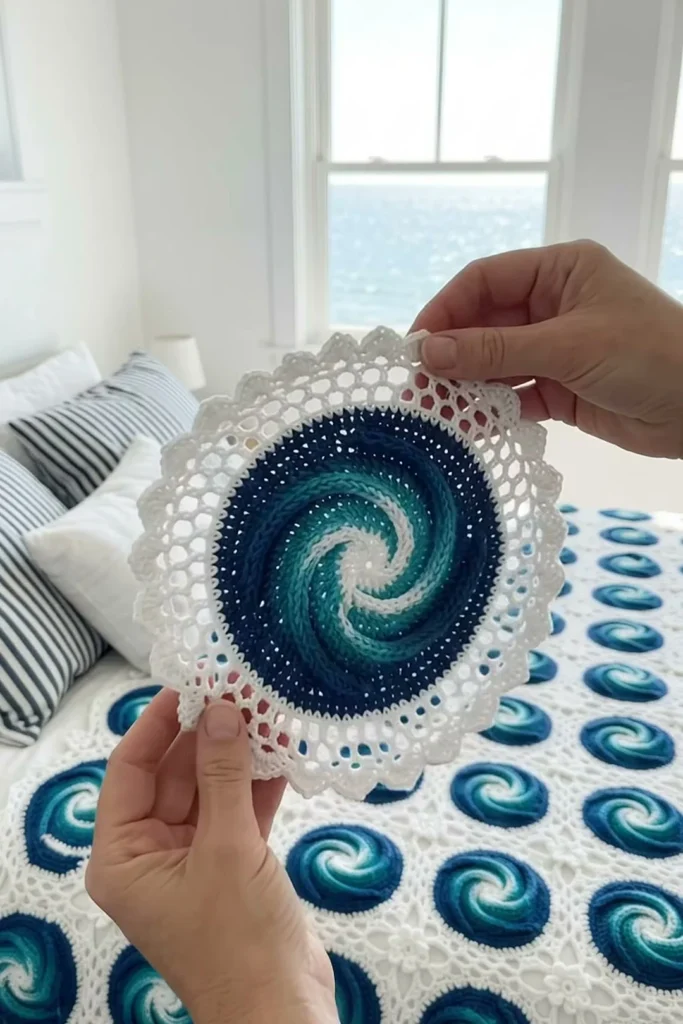
Ocean Wave Swirl Crochet Bedspread
Intermediate
For crocheters comfortable with the basics, ready to try new shaping and assembly techniques
Multi-Day Project
A rewarding 12+ hour journey — perfect for dedicated crafters who love detailed work.
Handmade Gift
A beautiful keepsake — free forever. Read online or print at home.
 Magic ring & first rounds
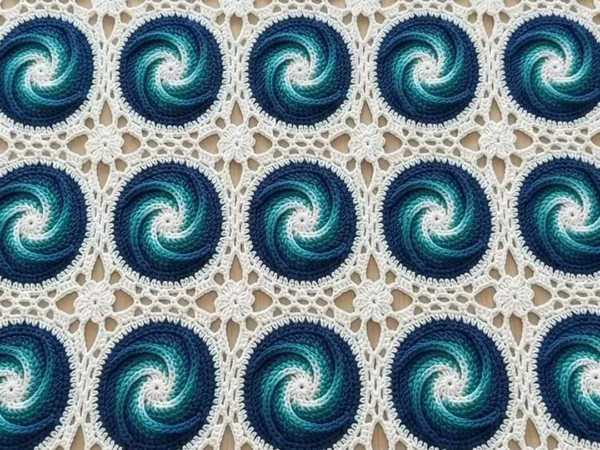 Building the shape
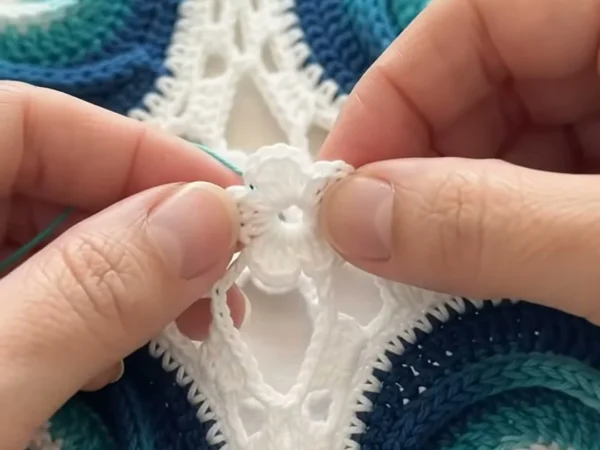 Assembly in progress
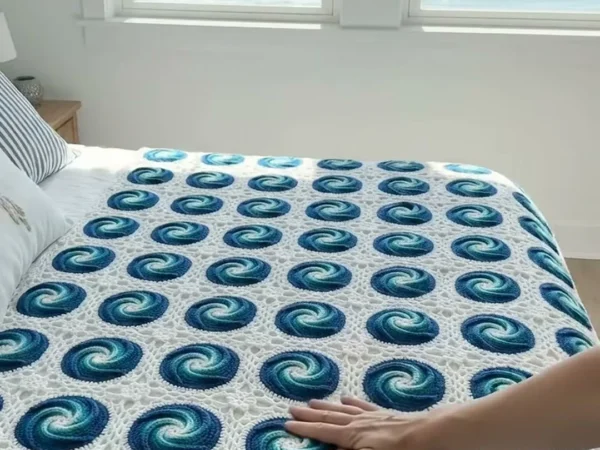 Finished & ready!
About This Ocean Wave Swirl Crochet Bedspread
This ocean wave crochet bedspread looks like a beach-house view in yarn: round motifs with a raised swirl that shades from a white center through aqua and teal to deep navy, so each one looks like a curling wave. A white lace ring with a scalloped edge frames every swirl, and tiny white flowers join the motifs where four of them meet.
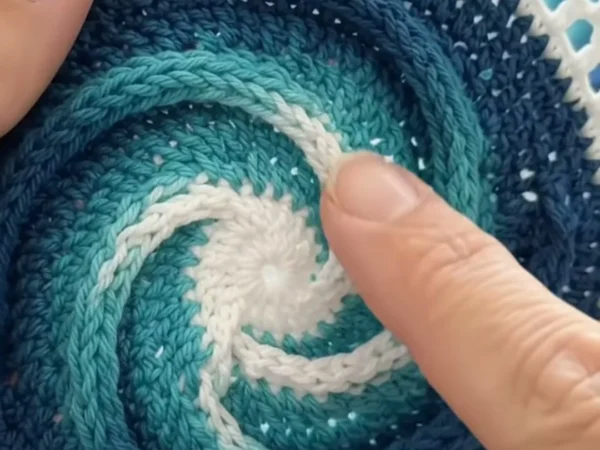
The swirl is made with front post double crochet. Each round you move the post stitch one stitch along, so twelve raised ridges curve out from the center like a spiral. Color changes on the way out make the white-to-navy wave. The lace ring is a simple mesh and a round of scallops, and the motifs join to each other as you work that last round, so there is no sewing.
A bedspread takes about 100 to 120 hours, and a throw about 40 to 45. One motif takes around 50 minutes. The pattern suits a crocheter who is comfortable with double crochet and ready to try front post stitches.
Materials
- DK weight yarn, white about 2,350 m for a bedspread (10 skeins of 100 g / 250 m), or 900 m for a throw (4 skeins), for the centers, lace rings and flowers
- DK weight yarn, navy blue about 1,800 m for a bedspread (8 skeins), or 700 m for a throw (3 skeins)
- DK weight yarn, teal about 1,200 m for a bedspread (5 skeins), or 450 m for a throw (2 skeins)
- DK weight yarn, aqua about 400 m for a bedspread (2 skeins), or 150 m for a throw (1 skein)
- 4 mm (G-6) crochet hook
- Stitch markers to mark the first st of each rnd and the join points
- Blocking mats and rust-proof pins
- Tapestry needle and scissors
Abbreviations
MRmagic ringchchainsl stslip stitchscsingle crochethdchalf double crochetdcdouble crochetfpdcfront post double crochet: yarn over, insert the hook from front to back to front around the post of the st, and work a dcspspaceskskipst(s)stitch(es)rndroundreprepeatRS / WSright side / wrong sideHow the Swirl Works
The swirl is a flat circle of double crochet with 12 raised ridges. Each ridge is a front post double crochet (fpdc), which sits on top of the fabric instead of in it. On every round you work the new fpdc around the stitch just after the old one, then a dc into the top of that same stitch. That one move does two jobs: it adds 12 stitches per round so the circle stays flat, and it shifts every ridge one stitch along, so the straight spokes bend into a spiral.
After Rnd 4 the rule never changes: work a dc in each stitch up to the post, a dc in the top of the post, then the new post and its partner dc. Count the stitches between two posts at the end of a round; that number goes up by one every round, so you can always check where you are.
The ocean colors follow the swirl outward: white at the center like sea foam, then aqua, teal and navy. Change color at the join with the last yarn-over of the sl st, and the color lines will run along the curve of the ridges like a breaking wave.
Sizes and How Many Motifs
- Each joined motif takes up about 20 x 20 cm, and the free scallops add about 2 cm on each outer edge.
- Baby blanket: 4 x 5 = 20 motifs and 12 flowers, about 80 x 100 cm.
- Throw: 6 x 7 = 42 motifs and 30 flowers, about 120 x 140 cm.
- Twin bedspread: 8 x 11 = 88 motifs and 70 flowers, about 160 x 220 cm.
- Queen bedspread: 10 x 11 = 110 motifs and 90 flowers, about 200 x 220 cm.
- King bedspread: 12 x 11 = 132 motifs and 110 flowers, about 240 x 220 cm.
- Yarn per motif, to plan any size: about 19 m white, 16 m navy, 11 m teal and 4 m aqua. Each flower uses about 3 m of white.
Wave Swirl (make 110 for a bedspread, 42 for a throw)
- Every rnd starts with ch 2 (does not count as a st) and is joined with a sl st to the first st. Change color at the join where the pattern says so.
- Rnd 1: with white, MR, ch 2, 12 dc in ring, join. Pull the ring tight. (12 sts)
- Rnd 2: ch 2, *fpdc around next st, dc in top of same st; rep from * 11 more times, join. (24 sts, including 12 fpdc)
- Rnd 3: change to aqua. Ch 2, *dc in top of next fpdc, fpdc around next st, dc in top of same st; rep from * 11 more times, join. (36 sts)
- Rnd 4: change to teal. Ch 2, *dc in each st up to the next fpdc, dc in top of the fpdc, fpdc around next st, dc in top of same st; rep from * 11 more times, join. (48 sts)
- Rnd 5: with teal, rep Rnd 4. (60 sts)
- Rnds 6-7: change to navy and rep Rnd 4 twice. Fasten off. (Rnd 6: 72 sts, Rnd 7: 84 sts)
- Each rnd, the fpdc moves one st forward, so the 12 raised ridges curve into a swirl. The swirl measures about 13 cm across.
White Lace Ring (worked on every swirl)
- Rnd 8: join white in any st. Ch 1, *sc in next 6 sts, 2 sc in next st; rep from * 11 more times, join with sl st to first sc. (96 sc)
- Rnd 9: ch 5 (counts as dc and ch 2), sk next 2 sts, *dc in next st, ch 2, sk next 2 sts; rep from * 30 more times, join with sl st to 3rd ch of ch 5. (32 dc, 32 ch-2 sps)
- Rnd 10: sl st in next ch-2 sp, ch 1, sc in same sp, *ch 4, sc in next ch-2 sp; rep from * 30 more times, ch 4, join with sl st to first sc. (32 ch-4 loops)
- Rnd 11 (first motif only): sl st in next ch-4 loop, ch 1, sc in same loop, *7 dc in next loop, sc in next loop; rep from * 14 more times, 7 dc in last loop, join with sl st to first sc. Fasten off. (16 scallops)
- Count the scallops as 4 sides of 4 scallops each. The 2 middle scallops of each side join to the next motif; the 2 scallops at each corner stay free for the flowers.
Joining as You Go
- Layout: 10 motifs across and 11 long for a bedspread, or 6 across and 7 long for a throw. Work across each row, then start the next row.
- Work Rnds 1-10 of the next motif as usual. Work Rnd 11 until you reach the first scallop that must join a finished motif.
- Joining scallop: work 4 dc in the loop, sl st in the 4th (center) dc of the matching scallop on the finished motif, then work 3 dc in the same loop. (7 dc, 1 join)
- Join the next scallop the same way, then finish the rnd as usual. (2 joined scallops per shared side)
- For motifs in the second row and on, join the 2 middle scallops of the top side to the motif above and the 2 middle scallops of the left side to the motif on the left.
Tiny White Flowers (make 90 for a bedspread, 30 for a throw)
- Work one flower in each diamond-shaped gap where four motifs meet. Each gap has 8 free scallops around it, 2 from each motif.
- Rnd 1: with white, MR, ch 1, 8 sc in ring, join with sl st to first sc. Pull the ring tight. (8 sts)
- Rnd 2: *(sc, hdc, dc, ch 1, sl st in the center dc of the next free scallop, ch 1, dc, hdc, sc) in next st; rep from * 7 more times, join. Fasten off. (8 petals, each joined to 1 scallop)
- The flower is about 6 cm across and holds the four motifs together at their corners.
Straight Edge Border (optional)
- Skip this part if you like the wavy scalloped edge in the photos. Work it if you want the bedspread to hang straight down the sides of the bed.
- Half flowers: fill each gap along the outer edge where two motifs meet. With white, MR, ch 1, 5 sc in ring, do not join. Turn. (5 sts)
- Half flower Row 2: *(sc, hdc, dc, ch 1, sl st in the center dc of the next free scallop, ch 1, dc, hdc, sc) in next st; rep from * 3 more times, sc in last st. Fasten off. (4 petals, each joined to 1 scallop)
- Rnd 1: with white, join in the center dc of a corner scallop. Ch 1, sc in same st, *ch 5, sc in the center dc of the next free scallop; rep along each motif side, and at each half flower work ch 3, sc in the last sc of the half flower, ch 3. At the 4 outer corners work (sc, ch 7, sc) in the corner scallop. Join.
- Rnd 2: ch 1, sc in each sc and 5 sc in each ch-5 loop, 3 sc in each ch-3 loop and 9 sc in each corner ch-7 loop. Join. (6 sts per ch-5 loop)
- Rnd 3: ch 1, sc in first st, *sk 2 sts, 5 dc in next st, sk 2 sts, sc in next st; rep from * around, easing in 1 or 2 extra sts at each corner as needed. Join and fasten off.
- The border is about 5 cm wide and gives a straight edge with a small shell finish.
Matching Wave Cushion
- Front: make 4 motifs and join them in a square, 2 x 2, as for the bedspread. Work 1 white flower in the center gap.
- Fill the 4 edge gaps with half flowers, then work Rnds 1-2 of the Straight Edge Border. The front measures about 42 cm square.
- Back: cut a piece of navy cotton fabric 45 x 45 cm, or crochet a navy square in rows of hdc to the same size.
- Sew the front to the back around 3 sides with white yarn, insert a 40 cm cushion form and sew the last side closed.
Finishing
Weave in all ends on the WS, running each color under stitches of the same color: navy under navy, white under the lace. The color-change tails hide best in the post-stitch ridges.
Lay the bedspread flat on a sheet or blocking mats, mist it with water and pin the scallops along the outer edges into even waves. Let it dry completely. The free scallops around the edge make a wavy border, so no extra border is needed.
Tips for Success
- Place a marker in the first fpdc of each rnd. It shows you where the swirl moves and makes counting easy.
- Make all the swirls first, then add the lace rings in a second batch. The color changes are done in one go and the white lace stays clean.
- Keep the post stitches at the same tension as the dc. Tight posts make the swirl cup; loose ones make the ridges flat.
- Lay out a few finished motifs before you join them, and spread any slightly different shades of navy evenly across the bed.
- Block one motif before you start the join, so you know the scallops are the right size to meet their neighbors.
- Change colors in the same spot every round, right at the join, so the color change lines up behind one ridge and stays hidden.
- If you make a bedspread, keep a tally sheet: 110 motifs and 90 flowers are easier to track in groups of ten.
Common Mistakes to Avoid
- A swirl that cups into a bowl. Check the count at the end of each rnd; every rnd must add 12 sts. Missing the “dc in top of same st” after a post st is the usual reason.
- Straight ridges instead of a spiral. The fpdc has to go around the st after the old post, not around the old post itself.
- A lace ring that ruffles. Rnd 8 must have 96 sc and Rnd 9 exactly 32 dc; skip 2 sts each time, not 1.
- Joins on the wrong scallops. Count 4 scallops per side before you start Rnd 11 and mark the 2 middle ones of each joining side.
- Loose flowers. Each petal must sl st into the center dc of a free scallop; if a petal skips one, the corner of a motif will flap.
- Color lines that zigzag. Join the new color with the sl st of the round before, not with the first ch of the next round.
- Motifs joined in the wrong order. Always join to the motif above first and then to the left, or the rows will shift.
Ways to Customize This Pattern
- Make a sunset version: yellow center, then orange, coral and deep red, with a cream lace ring.
- Use one blue for the whole swirl and only change the lace color, for a quicker motif with fewer ends.
- Change the size: each motif adds about 20 cm. A baby blanket of 4 by 5 motifs is about 80 x 100 cm.
- Make a matching cushion from 4 motifs and 1 flower, sewn to a navy fabric back.
- Leave out the flowers and join the corner scallops to each other for a lighter, more open lace.
- Make a lagoon version in mint, turquoise and deep green with a cream lace ring.
Frequently asked questions
No. Once you have made Rnd 4, every rnd follows the same rule: dc up to the post, dc in the top of the post, then a new post in the next st. The swirl forms on its own.
110 motifs (10 x 11) for a bedspread of about 200 x 220 cm, or 42 motifs (6 x 7) for a throw of about 120 x 140 cm. You also need one flower for every gap where four motifs meet.
Yes, with a 5 mm hook. The motifs will be about 25 cm across, so you need fewer of them, and the blanket will be heavier and warmer.
Wash it on a gentle cold cycle inside a large laundry bag, or by hand, and dry it flat. Wash a scrap of navy with white first to make sure the dark blue doesn’t bleed into the lace.
About 35 minutes for the swirl and 15 minutes for the lace ring once you know the pattern. Joining adds a few minutes per motif.
The back is flat and smooth, because the post stitches sit on the front. The bedspread is not reversible, but the back looks neat.
A flat circle of double crochet needs about 12 new stitches per round. Using 12 ridges, each with one increase, keeps the swirl flat without extra increases.