Wildflower Meadow Crochet Blanket
Advanced
For experienced crocheters who enjoy complex shaping, fine detail, and ambitious construction
Weekend Project
A satisfying weekend make — start Friday, finish Sunday, enjoy forever.
Handmade Gift
A beautiful keepsake — free forever. Read online or print at home.
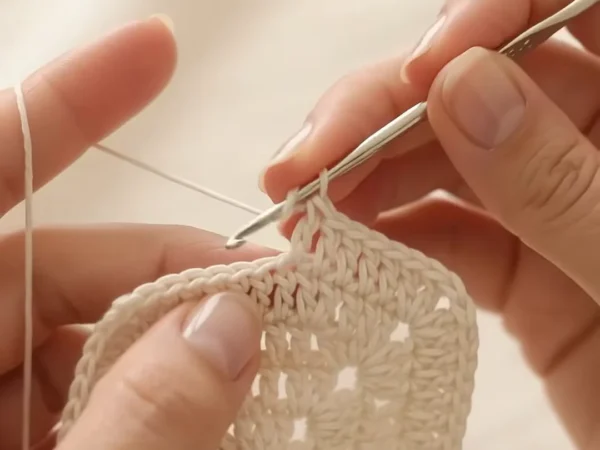 Magic ring & first rounds
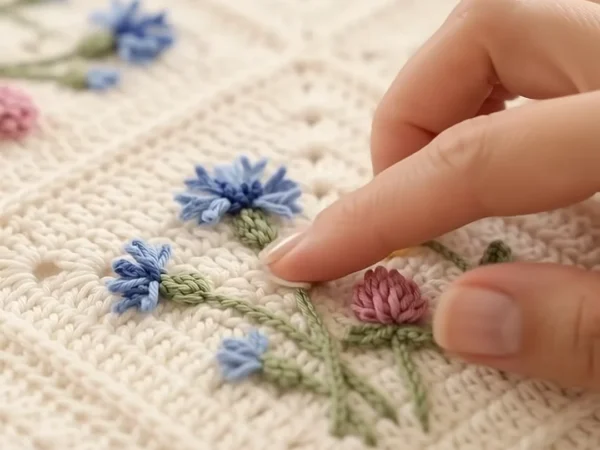 Building the shape
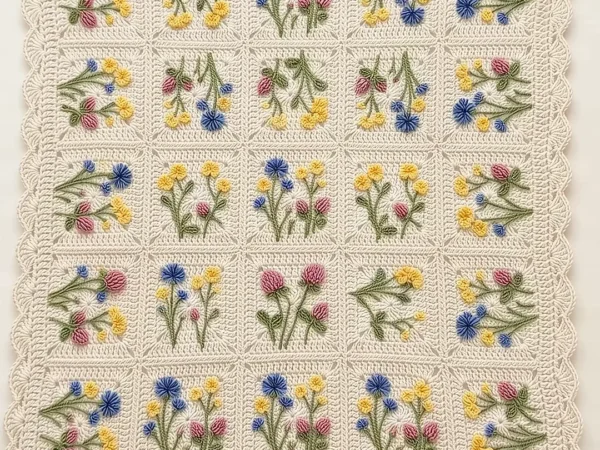 Assembly in progress
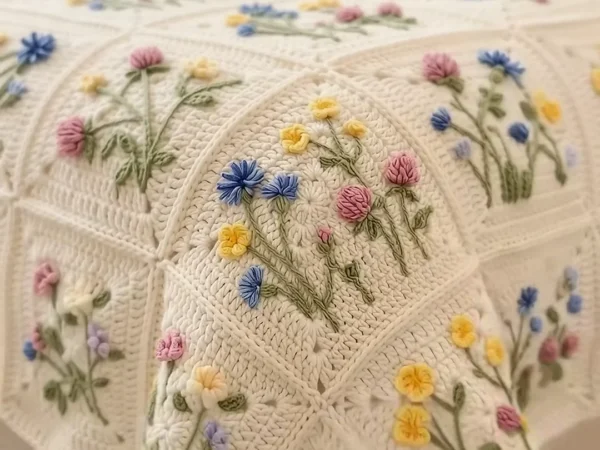 Finished & ready!
About This Wildflower Meadow Crochet Blanket
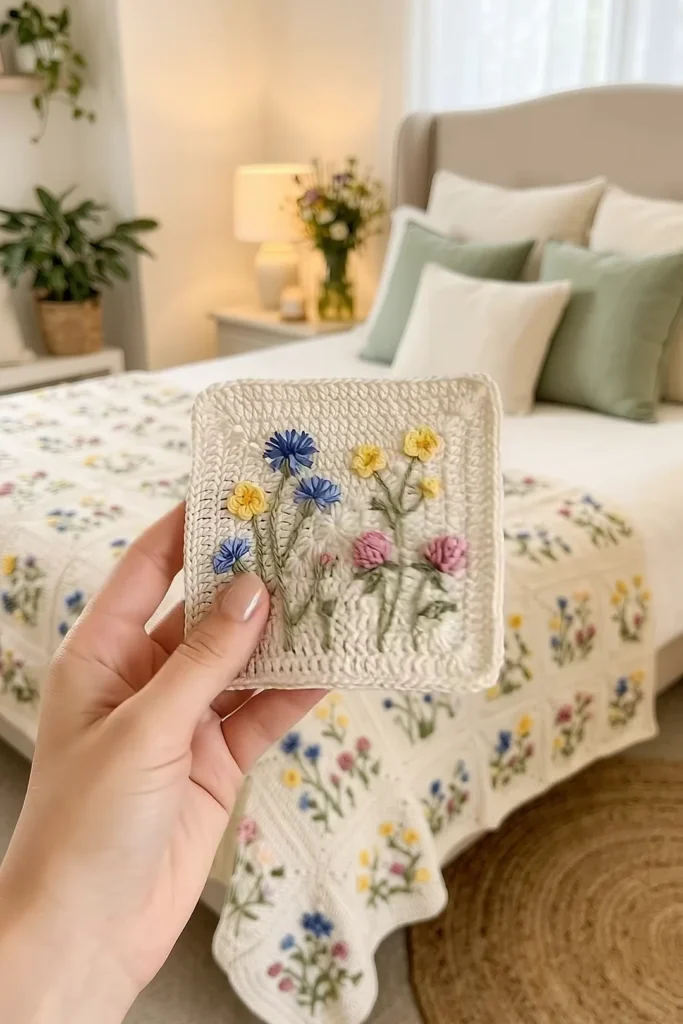
This wildflower crochet blanket pattern puts a little summer meadow on every square: blue cornflowers with spiky petals, cupped yellow buttercups and fluffy pink clovers, all growing on green stems from the bottom of the square. The flowers are real 3D pieces, not embroidery, so you can touch every petal, and no two squares in the blanket are exactly alike.
The base is a solid cream square of double crochet with a ring of small eyelets near the edge, which frames each bouquet like a little window. The flowers are crocheted separately in layers, using front and back loops so the petals stand up, then sewn on. The stems are worked straight onto the square in surface slip stitch, and leaves are added along them. The squares are joined with a fine raised seam and finished with a deep scalloped border.
A queen bedspread takes about 160 to 175 hours and a throw about 72 to 80. One square with its flowers takes about 75 minutes. This is an advanced project for a crocheter who enjoys small detailed pieces and doesn’t mind a lot of sewing.
Materials
- DK weight cotton yarn, cream about 4,850 m for a queen (25 balls of 100 g / 200 m), or 2,120 m for a throw (11 balls)
- DK weight cotton yarn, cornflower blue about 660 m for a queen (4 balls), or 280 m for a throw (2 balls)
- DK weight cotton yarn, buttercup yellow about 530 m for a queen (3 balls), or 225 m for a throw (2 balls)
- DK weight cotton yarn, clover pink about 440 m for a queen (3 balls), or 190 m for a throw (1 ball)
- DK weight cotton yarn, sage green about 530 m for a queen (3 balls), or 225 m for a throw (2 balls)
- Navy and orange embroidery floss for the flower centers
- 4 mm (G-6) crochet hook for the squares, joining and border
- 3.5 mm (E-4) crochet hook for the flowers and leaves
- Stitch markers, sewing pins, tapestry needle and scissors
Abbreviations
MRmagic ringchchainsl stslip stitchscsingle crochethdchalf double crochetdcdouble crochetFLO / BLOfront loop only / back loop onlysurface sl stwith the yarn held behind the square, insert the hook from the front, pull up a loop and draw it through the loop on the hookspspaceskskipst(s)stitch(es); in the eyelet rnd each ch-1 sp counts as 1 strndroundreprepeatRS / WSright side / wrong sideCream Square (make 132 for a queen, 56 for a throw)
- Rnd 1: with cream and the 4 mm hook, MR, ch 3 (counts as dc here and throughout), 2 dc in ring, ch 2, *3 dc in ring, ch 2; rep from * 2 more times, join with sl st to top of ch 3. Pull the ring tight. (12 dc, 4 corner ch-2 sps)
- Rnd 2: sl st in next 2 dc and in corner sp, ch 3, (dc, ch 2, 2 dc) in same sp, *dc in each dc to next corner sp, (2 dc, ch 2, 2 dc) in corner sp; rep from * 2 more times, dc in each remaining dc, join. (28 dc: 7 per side)
- Rnd 3: sl st in next dc and in corner sp, then work as Rnd 2. (44 dc: 11 per side)
- Rnd 4: rep Rnd 3. (60 dc: 15 per side)
- Rnd 5 (eyelets): sl st in next dc and in corner sp, ch 3, (dc, ch 2, 2 dc) in same sp, *dc in next dc, (ch 1, sk next dc, dc in next dc) 7 times, (2 dc, ch 2, 2 dc) in corner sp; rep from * 2 more times, dc in next dc, (ch 1, sk next dc, dc in next dc) 7 times, join. (19 sts per side, including 7 eyelets)
- Rnd 6: sl st in next dc and in corner sp, ch 3, (dc, ch 2, 2 dc) in same sp, *dc in each dc and in each ch-1 sp to next corner, (2 dc, ch 2, 2 dc) in corner sp; rep from * 2 more times, dc in each remaining st, join. (23 dc per side)
- Rnd 7: sl st in next dc and in corner sp, then work as Rnd 2. (27 dc per side)
- Rnd 8: ch 1, sc in each dc around, 3 sc in each corner sp, join. Fasten off. (29 sc per side, counting the corner sc at each end) Block to 18 x 18 cm.
Cornflowers (blue)
- Rnd 1: with blue and the 3.5 mm hook, MR, ch 1, 6 sc in ring, join with sl st to first sc. Pull tight. (6 sts)
- Rnd 2 (inner petals, FLO): *sl st in FLO of next st, ch 4, sl st in 2nd ch from hook, sc in next 2 ch; rep from * 5 more times. (6 short petals)
- Rnd 3 (outer petals, BLO of Rnd 1): *sl st in BLO of next st of Rnd 1, ch 6, sl st in 2nd ch from hook, sc in next 2 ch, hdc in next 2 ch, ch 5, sl st in 2nd ch from hook, sc in next 3 ch; rep from * 5 more times, join. Fasten off with a 25 cm tail. (12 long petals)
- Center: with navy floss, work 3 French knots in the middle.
- The cornflower is about 4 cm across. Make 2 for square A, 1 for square B and 2 for square C.
Buttercups (yellow)
- Rnd 1: with yellow, MR, ch 1, 5 sc in ring, join. Pull tight. (5 sts)
- Rnd 2 (petals, FLO): *(sc, hdc, dc, hdc, sc) in FLO of next st; rep from * 4 more times, join. (5 petals)
- Rnd 3 (back petals, BLO of Rnd 1): *sl st in BLO of next st, ch 3, sl st in same st; rep from * 4 more times, join. Fasten off with a 20 cm tail. (5 small loops that push the petals forward into a cup)
- Center: with orange floss, work 1 French knot wrapped 3 times.
- The buttercup is about 3 cm across. Make 2 for square A, 3 for square B and 1 for square C.
Clovers (pink)
- Rnd 1: with pink, MR, ch 1, 6 sc in ring, join. Pull tight. (6 sts)
- Rnd 2 (FLO): *(sc, ch 3, sc) in FLO of next st; rep from * 5 more times, join. (6 short loops)
- Rnd 3 (BLO of Rnd 1): *(sc, ch 4, sc) in BLO of next st; rep from * 5 more times, join. Fasten off with a 25 cm tail. (6 long loops)
- Fold the flower in half with the loops outside and sew the two halves together at the base, so the loops bunch into a round, fluffy clover head about 2.5 cm tall.
- Make 1 for square A, 1 for square B and 2 for square C.
Stems and Leaves
- Plan the bouquet: pin the flowers on the square inside the eyelet ring, at different heights, with the tallest flower in the middle.
- Stems: with green and the 3.5 mm hook, start just above the eyelet ring at the bottom center of the square. Work surface sl st up to each flower, about 1 st per dc row, curving the stems a little. Start every stem from the same 2 or 3 points at the bottom so the bouquet looks tied.
- Leaves: with green, ch 7, sl st in 2nd ch from hook, sc in next ch, hdc in next ch, dc in next ch, hdc in next ch, sc in last ch. Fasten off with a 15 cm tail. (6 sts) Make 3 or 4 per square.
- Sew the leaves to the stems by their base, pointing up and out, so their tips stay free.
- Sew each flower to the top of its stem from the WS of the square, through the center ring only, so the petals stay loose and 3D.
Joining the Squares
- Layout: 11 x 12 = 132 squares for a queen (about 208 x 226 cm with the border), 7 x 8 = 56 for a throw (about 136 x 154 cm), or 5 x 8 = 40 for a single bed (about 100 x 154 cm). Square layouts: A = 2 cornflowers, 2 buttercups, 1 clover; B = 1 cornflower, 3 buttercups, 1 clover; C = 2 cornflowers, 1 buttercup, 2 clovers.
- Lay out the squares in the order A, B, C, A, B, C… across each row, starting each new row with the next letter, so the same layout never sits side by side.
- Keep all the stems pointing to the same edge, which becomes the foot of the bed.
- With cream and the 4 mm hook, hold two squares WS together and sl st through the outer loops of each pair of sc, from corner to corner. (29 sl st per side, from corner sc to corner sc)
- Join all the horizontal seams first, then the vertical ones, working through all four corner sc at each crossing.
- The sl st seam makes the thin raised line between the squares that you see in the photos.
Scalloped Border
- Rnd 1: with cream and the 4 mm hook, join in any corner. Ch 3, dc in each st around, 1 dc in each seam and 5 dc in each corner st. Join.
- Rnd 2: ch 3, dc in each st around, 5 dc in each center corner st. Count the sts on each side and add or skip 1 or 2 near the corners to get a multiple of 6 plus 1. Join.
- Rnd 3: ch 1, sc in first st, *sk 2 sts, 7 dc in next st, sk 2 sts, sc in next st; rep from * around, working 9 dc in each center corner st. Join.
- Rnd 4: ch 1, sc in each st around, working 2 sc in the 4th dc of each scallop. Join and fasten off.
Finishing
Weave in every flower tail on the WS of the square it belongs to, under the solid dc, never across the eyelets. The cream square hides green and blue tails well if you weave them through two or three dc and back.
Lay the blanket flat RS up, mist it with water and pin the border scallops out. Gently pull each petal into shape with your fingers and leave the flowers standing up; do not press them. Let it dry completely before you move it.
Tips for Success
- Make the flowers in front of a TV in big batches: all cornflowers, then all buttercups, then all clovers. Store each kind in its own bag.
- Work the stems before sewing on any flower; it is much easier to place the surface sl st when nothing is in the way.
- Keep the stems on the solid part of the square, inside the eyelet ring, so the eyelets stay open and visible.
- Use the long tail of each flower to sew it, so you have fewer ends to weave in.
- Take a photo of your first A, B and C squares and follow them for the rest, so the layouts stay the same through the blanket.
Common Mistakes to Avoid
- A square that is not square. Make sure every round starts in a corner sp; starting at a side makes one corner bigger.
- The wrong number of eyelets. Rnd 5 needs 15 dc per side from Rnd 4, which gives exactly 7 eyelets. Count Rnd 4 before you start the eyelets.
- Flat flowers. Rnd 2 must go in the front loops only and the next rnd in the back loops; working in both loops leaves no room for the second layer.
- Puckered stems. Surface sl st that is too tight pulls the square in. Keep the loops loose and the yarn relaxed at the back.
- Flowers that droop. Sew through the center ring of each flower, not just one petal, or the flower will tip forward when the blanket hangs.
Ways to Customize This Pattern
- Add other wildflowers: white daisies with a yellow center, purple lavender sprigs made of French knots, or red poppies worked like the buttercup with black centers.
- Use pale sage or light blue for the squares and keep the flowers the same for a fresh spring color scheme.
- Make a baby blanket of 20 squares with the flowers embroidered flat instead of 3D, so nothing can be pulled off.
- Make a set of 4 matching cushions, each with a single big bouquet across 4 squares.
- Alternate flower squares with plain cream squares for a quicker blanket that still looks like a meadow.
Frequently asked questions
With 132 squares in the A, B, C order you need 220 cornflowers, 264 buttercups and 176 clovers, plus about 460 leaves. A throw of 56 squares needs about 93 cornflowers, 112 buttercups and 75 clovers.
Yes. Lazy daisy stitches and French knots make a flat version that is much quicker and better for babies, but you lose the 3D petals that make this blanket special.
Cotton holds the shape of small petals and loops much better than acrylic, so the cornflowers stay spiky and the clovers stay round. A cotton blend also works if you want a softer, warmer bedspread.
You can join Rnd 8 of each square to its neighbors as you go, but do the stems and flowers first. It is very hard to work surface sl st on a square that is already part of a big blanket.
Wash it on a gentle cold cycle inside a large laundry bag and dry it flat, then fluff the flowers with your fingers. Wash a scrap of each color with cream first so the blue and pink don’t bleed.